Category News

[open access] Responding to the COVID-19 pandemic in complex humanitarian crises

Over 168 million people across 50 countries are estimated to need humanitarian assistance in 2020 [1]. Response to epidemics in complex humanitarian crises—such as the recent cholera epidemic in Yemen and the Ebola epidemic in the Democratic Republic of Congo—is a global health challenge of increasing scale [2]. The thousands of Yemeni and Congolese who have died in these years-long epidemics demonstrate the difficulty of combatting even well-known pathogens in humanitarian settings. The novel severe acute respiratory syndrome coronavirus-2 (SARS-CoV-2) may represent a still greater threat to those in complex humanitarian crises, which lack the infrastructure, support, and health systems to mount a comprehensive response. Poor governance, public distrust, and political violence may further undermine interventions in these settings.

Resisting Borders: A Virtual Conference on Refugee & Migrant Health, Mobility, Human Rights & Responsibilities (June 2020)

First convened in 2017, Resisting Borders: Refugee and Migrant Health and Responsibilities is a no travel, online, no fee conference aimed at discussing ethical issues surrounding responsibilities for the health of refugees, asylum-seekers, and other migrant and displaced people.

We are now inviting contributions for a second conference to be held in June 15th, 16th, 17th and 18th 2020, 7 am – 9 am Eastern Standard Time, as a satellite to the World Congress of Bioethics.

As before, we will convene for a few hours during each of the four days.

The theme of the 2020 Resisting Borders conference will be Caring on the Landscape of Displacement: Mapping Moral Experience in Health Services for Migrants.

Major depressive disorder prevalence and risk factors among Syrian asylum seekers in Greece

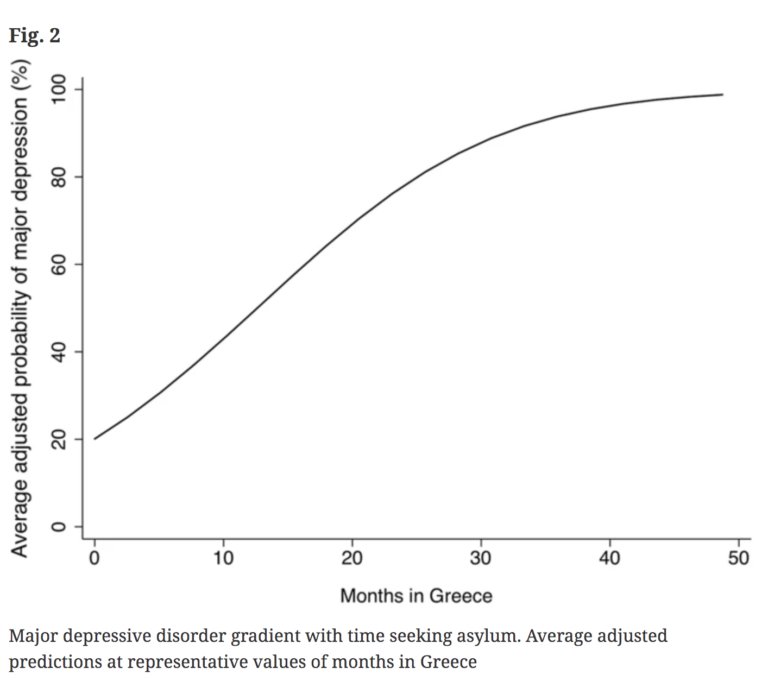
Graph that shows the more time spent in camp the higher the probability of MDD

This research provides necessary information on the mental health (specifically major depressive disorder or MDD) of refugees from Syria, as this information has not been collected or analyzed thoroughly as of yet. The researchers surveyed 135 Syrian refugees in a camp in Greece, specifically screening for MDD. The authors found that 44% of participants had symptoms of major depression. They found that women had an increased likelihood of MDD, and that time spent in the camp had a trend towards increased risk of depression.